Rod Noble and Samantha Dagg
The Hunter region has been the site of extensive labour struggles and activism dating from early colonial settlement and provides a rich field of research for labour historians. The following paper identifies and introduces five key labour history hubs in the region.
Some background
The land of the Newcastle and Hunter Region belongs to the Awabakal, Worimi and associated First Nations people. The establishment of convict settlements and seizure of land in the Hunter Region was undertaken by the colonial regime of the United Kingdom.
The rich and extensive history of the Hunter Region Labour Movement begins with convict labourers, including those transported for political activity. Convicts began mining coal in Newcastle in the early 1800s (first in 1801, more permanently from 1804). Newcastle became a so-called “free settlement” in 1823, which meant non-convicts were able to reside along with convicts and the military.
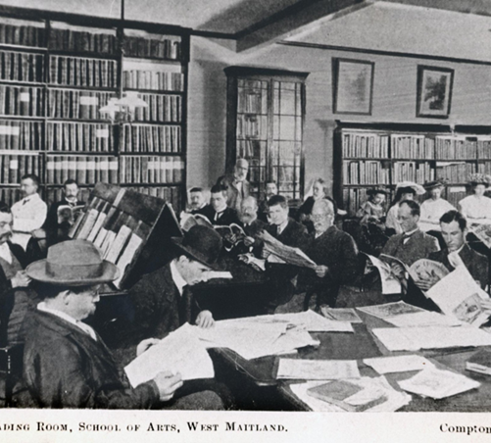
Early political influences in Newcastle and the Hunter Valley included convicts from Northern England who had been transported due to strike activity and association with unionism in 1832. Also, some of the “Tolpuddle Martyrs” had been transported to the Hunter Valley in 1834, for attempting to form “Combinations”. Over the ensuing years union organisations developed alongside waves of immigration, mainly from England, Scotland, Wales and Ireland. These immigrants brought with them ideas of working-class organisations including educational institutions such as Mechanics Institutes and Schools of Arts. These became precursors to the public libraries we now have.
Due to the early dominance of coal mining and the social-cultural mores that went with it, the Hunter region became noted as a very militant region. This was highlighted by the region suffering at least two military occupations due to conflict over various industrial issues. Each of these occupations went more than 3 months (in 1879 and again in 1888) and required much of the NSW Army Regiment along with their Artillery and Gatling guns to suppress the miners. Each of these occasions involved the colliery owners trying to import strike breakers (Scabs) against the will of the majority of the mining community.
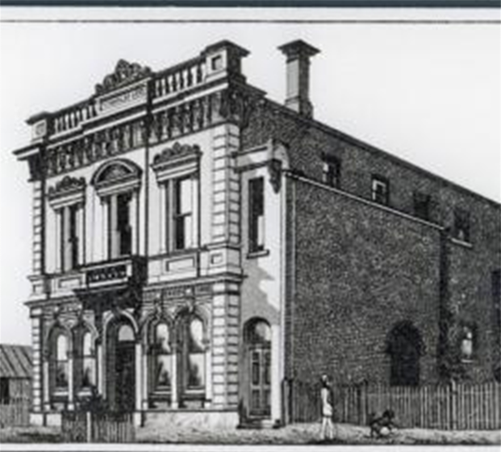
These struggles from the coal mining communities, and those for an Eight Hour Day and eventually a 40-hour week, went on alongside the many others involving waterside workers and seafarers. The Hunter Valley became rich in the history of these struggles, some resulting in wins and some in losses. The Eight Hour Committee was successful in establishing Newcastle’s first Trades Hall building in 1895 in Hunter Street, and a larger one was built in 1914 in Union Street to cope with the rapid growth of unions.
In the period leading up to and during WW1 new levels of militancy developed under the influence of socialist ideas, the Industrial Workers of the World (IWW) and the One Big Union (OBU) movement. In 1924, the then Newcastle Industrial Council set up its own library to help educate its members. It was named the “Percy Brookfield Memorial Library” and was housed in the Trades Hall in Union Street. In 1926 the then Eight Hour Committee, which had formed in 1869, made a successful move to unify what had been a disunited movement during and immediately after WW1. The Eight Hour Committee changed its name to Newcastle Trades Hall Council (NTHC), and the majority of unions came under that umbrella.
Politically it is noted for, amongst other things, having a militant CPA leadership from 1943, which continued even after the CPA itself dissolved in 1991.
Today the NTHC still holds the NTHC legal entity but trades as “Hunter Workers”. It is housed in a large three-story building in one of the main streets of the city.
Labour History Hubs in the Hunter Valley
The archival history of the aspects of the Labour Movement mentioned above are available in five identifiable hubs. These hubs include union histories, industrial relations, workplace health, political history, economic history, cultural history, women’s movement, peace movement, environment, and much more.
HUB 1: Newcastle City Library
Location: 15 Laman St, Cooks Hill, Newcastle. NSW. 1 kilometre from Newcastle CBD
Access: The Local History library is accessible 6 days a week. Monday to Friday times can be longer on some days than others and the opening hours on Saturday are shorter. It is best to check online for opening hours. https://newcastlelibraries.com.au/connect/visit/our-branches/local-history
Newcastle Libraries are the archival repository for the records of the City of Newcastle and holds other significant archival collections from public institutions, private companies and individuals. Newcastle Libraries is also a regional repository for State Records of NSW. As a public library they have the associated funding and skilled staff to assist a wide variety of local historians.
They have a dedicated Local History Library located in the Newcastle Branch of the Library on Laman Street (opposite the Town Hall) in Newcastle itself. It typifies what we understand to be a local history library, containing books, manuscripts, town plans, maps, pamphlets, posters, development applications and other ephemera. Many items of interest are held onsite either in the Local History section or in the Stacks. Other items of significance are held in archives off-site and are available on request.
It is a very useful ancillary resource for any labour researcher, providing the backdrop of the broader socio-cultural, economic, geographic and industrial landscape in which local labour activities were taking place, with a rich variety of material on the local area, in particular foundational and influential organisations, and major industries in Newcastle, including:
- BHP and other steel manufacturing industries,
- the State Dockyards, and other industrial organisations and activities in the Harbour and Hunter River
- early coalmining in the Newcastle region and the Northern Coalfields
- the Newcastle Trades Hall Council and other significant unions
In 2019 the library secured a grant to assist in digitising their collection with the increasing collection now available for viewing online via the Newcastle Stories on their webpage.
HUB 2: Jim Comerford Collection
The Sir Edgeworth David Memorial Library & Northern Coalfield Museum, Abermain, Hunter Valley, NSW.
Location: Abermain, near Cessnock. 41 kilometres from Newcastle CBD.
Access: Access is two or three days per week for 4 hours each day.
Volunteer-run organisation – catalogue/content not computerised (?). Appointment recommended.
The collection is contained in over 200 metres of library shelving and 6 filing cabinets, and includes the history of 666 Hunter Valley towns and settlements and 906 northern coal mines. It consists of 3,250,000 pages of information; 1,550 binders/boxes; 1,450 reference books; 10,000 photographs in books, documents, minutes and folders.
A sample of contents: Volumes of newspaper clippings from early 1940s onwards featuring coal industry issues, union issues and strikes; coal subsidence; mining under stored waters, reserves and parks; many books and compendiums such as “History of Trade Unionism 1866 – 1920” by Webb; “Environment Policy in Australia” by Alan Gilpin; and “The Energy Question” by Gerald Foley; Fatality Dartbrook, large arch folders and many other books and collections such as: “Retired mine workers” (4 large folders); “Industrial Relations” (15 folders); “Poetry” (12 folders); “Collections” – Jim Comerford (2 large folders and a book); Joint Coal Board reports” 1965-66 & 1971 – 1992 (20 volumes); Central Council Minutes (10 large volumes; volumes of documents 1934 and 1940; a History of West Wallsend Colliery; Wallsend and Pelton Collieries – a history; Mine Rehabilitation books; Happenings Under Belmont, a book; Mount Kembla Disaster, a book.
HUB 3 – University of Newcastle, Special Collections Archives
An archive with associated funding, specialty staff and infrastructure established in 1975, it is one of the oldest continuous archival repositories in the Hunter region.
Location: Auchmuty Library on Callaghan Campus. 10 kilometres from Newcastle CBD.
Access: By appointment. Mondays to Fridays; Two daily sessions: 10.00am–12.00pm & 1.00pm–3.00pm.
Special Collections comprises: The Rare Books & Special Collections; The University’s Archives, including over 2,000 metres of material; The GLAMX Living Histories Digitisation Lab and the Hunter Living Histories website. The latter two may be of particular interest to labour historians researching the Hunter Region.
Special Collections include the largest and most-well established labour archives within the Hunter, with material dating from early times. The focus on labour archives at the University of Newcastle is partly the result of the early militant and radical union activity in the region that developed alongside heavy industry, leading to the centrality of the labour movement in Newcastle and the Hunter Valley. Labour history in Newcastle, in many ways, is synonymous with the very history of Newcastle.
The Newcastle Trades Hall Council maintained a close working relationship with the University for many years, leading delegations and lobbying heavily from the 1940s onwards for the establishment of an autonomous regional university which was fully realised in 1965.
A significant portion of Special Collections Labour Archives is made up of the collections related to the Newcastle Trades Hall Council, the peak labour organisation in the Hunter: over 74 boxes and 8 volumes of material, dating from 1878 to the 1970s. To see the detailed listing of the archives held visit Newcastle Trades Hall and Labour | Living Histories.
The Copley Collection contains the personal archives of Merv and Janet Copley, consisting of hundreds of boxes of material on a broad spectrum of union and other left activism from the 1940s until the end of the 20th Century.
The Masterson Collection holds the personal papers of Stan Masterson, containing material on the intersection between the labour and Indigenous rights movement spanning from the late 1960s into the 2000s. While the collection is yet to be fully accessioned some ground-breaking research has been taking place by the Purai Global Indigenous History Centre at the University of Newcastle, with some of the material already available online.
Oral History collections, including “Voices of the Hunter”: over 800 oral histories of people from the coalfields in the Hunter (physical copies held by the Coalfields Local History Association); “Margaret
HUB 4: The Rod Noble Collection.
Location: 3 kilometres from Newcastle CBD.
Access: By appointment. Table space for viewing/reading/researching.
This extensive personal collection contains approximately three tonnes of archives, comprising 194 boxes of well-preserved and well organised archives that are accessible. They cover mainly Newcastle and the Hunter Region from the 1890s to 2024.
Topics in summary
Labour movement in general, individual unions; minutes of meetings, political parties and ancillary organisations associated with the labour movement; peace movement; women’s movement; economic development; environment movement; culture and cultural organisations; solidarity organisations; oral histories of significant identities associated with the Hunter Region Labour Movement.
Much of these archives are original and have not yet been digitised. Of particular interest are the many hundreds of original leaflets and newsletters from workplace campaigns and numerous community campaigns. There is a wealth of material for future research.
This archive also has a library of approx. 4,500 books and booklets on the Labour Movement and relevant political, social, economic and cultural aspects.
A plan for future housing of this archive is being considered.
HUB 5: Hunter Workers Library and Museum
Location: 2 kilometres from Newcastle CBD. Newcastle Trades Hall Council (Hunter Workers), 408 King Street, Newcastle.
Access: By appointment. Table space for viewing/reading/researching.
NTHC-HW has a tradition of libraries and archiving. There was a Brookfield Memorial Library established in the Newcastle Trades Hall from 1924 until approximately1948. (It was named after well-known trade unionist and member of parliament, Percy Brookfield, who had been a frequent visitor to Newcastle. He was murdered by a gunman in 1921 in Riverton, South Australia.) A library under the same name was established again in the Trades Hall from 1977 to 1989. NTHC also had a Research Officer in the 1960s until 1973 and again from 1977 until 1990. In that same period (1977 to 1990) a Research Centre was also established in the Trades Hall. This tradition was interrupted by the December 1989 Newcastle earthquake and the destruction of the Trades Hall and the Workers Club.
In 2014 a new mandate was established and as a result a new library was started in the new Trades Hall Building in King Street. It was conceived as a resource for unionists, in the style of the mechanics institutes, as well as museum style displays.
This new reprise is led by a small volunteer led team and has gradually built the library in a dedicated space to house some thousands of books, posters, pamphlets, documents, banners, badges and other artefacts of historical value. One feature is a section in the library of political-philosophical works underpinning the development and theoretical basis of trade unionism. It is currently continuing a gradual expansion with the assistance of significant donations from across the country.
There are plans to build a contemporary repository of material on NTHC and its affiliates and share this history across the affiliates and the wider community. It’s also planned to create partnerships with other local institutions, recentre the significance of the NTHC in the Hunter history, promote labour history locally and promote local labour history within the national context.
Possibilities for utilising these five hubs
- Increase awareness of what the various institutions hold including formalising and publicising the network of hubs.
- Encourage study of Labour History and use of the collections in the hubs.
- Utilise social media, a website, and other means, to promote catalogues as well as directing enquiries to the hubs where necessary. This could include use of common flyers displayed at all hubs, targeted advertising to relevant University departments at a national level, articles in relevant journals and publications.
- Target outreach/partnerships via already established local and national networks.
- Initiate & maintain contact between the repositories via partnerships.
Rod Noble is a Labour historian, a Life member of Newcastle Trades Hall Council (Hunter Workers) after serving for 46 years as a delegate, and a Life Member of the NTEU.
Samantha Dagg has been volunteer Co-ordinator of the Hunter Workers Library at the Newcastle Trades Hall Council since 2018, alongside her other employment.