Rowan Cahill and Terry Irving
Rowan Cahill and Terry Irving, both long-term members of Sydney Branch ASSLH, were two of the founders of Sydney’s Free U in the 1960s. In the article below, they turn joint authorship into an interactive dialogue between two voices, interweaving separate perspectives on aspects of the Free U story into a complex narrative. This is the definitive piece on the Free U.
Rowan: The Sydney Free U commenced courses in December 1967 and reached its peak during the Summer of 1968/69. Gradually thereafter it became financially unsustainable, and fragmented. Just when it ended is difficult to pinpoint, as reports of Free U style courses taking place in a variety of residential addresses in Sydney continued into the early 70s.
Initiatives inspired by the Sydney example took place in a number of metropolitan and regional centres across Australia but Sydney Free U was the most successful. Its foundational Manifesto titled ‘The Lost Ideal’, published in the Sydney student newspaper Honi Soit (3 October 1967) and signed by Rowan Cahill, Bob (later Raewyn) Connell, Brian Freeman, Terry Irving, and Bob Scribner, still resonates today. Education historian Cliff Turney included this document in his Sources in the History of Australian Education, 1788-1970 (Angus & Robertson, Sydney, 1975).
The Manifesto emerged from an afternoon meeting in 1967 of a small group of committed undergraduates and post-graduates/part-time tutors, all nearing completion of degrees.
Scene: The Front Lawn, Sydney University, just below the sandstone wall that bolsters the roadway between the entries to the Main Quad and the Great Hall. Sitting on the grass in relaxed earnestness, notebooks on hand, we came together to nut out a Manifesto. As publisher of Honi Soit I undertook to ensure publication and prominence, and get the ball rolling.
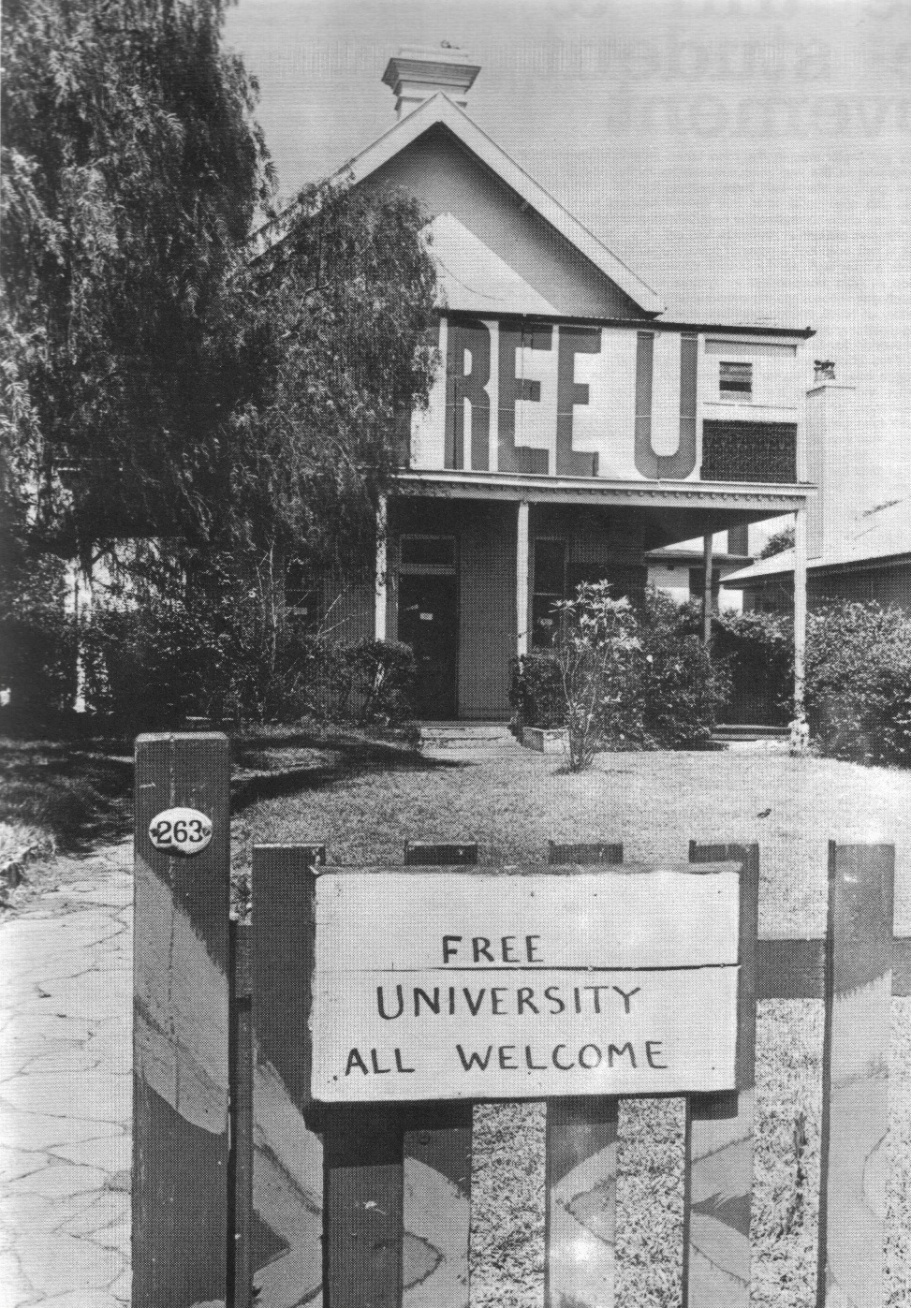
While there are notable exceptions, in many accounts of Australian campus activism during the 1960s and 70s the Free U is variously glossed over or ignored. Perhaps this is because it is easier to research and write about drama, physical conflict, demonstrations, protests, and political ideologies than it is to deal with something that attempted to grapple creatively with the relationships between education and power, with knowledge and its creation, and which sought to create a self-managing community modelling what a ‘university’ should be.
Terry: The Free U came out of a wave of student protest at the University of Sydney, a wave forced upwards by the resistance of short-sighted, powerful men. Then the wave broke – and this is an important clue to understanding Free U’s birth and death. Free U was more than an idealistic attempt to reform the University or radicalize knowledge; it was a moment in the history of the student movement.
It was the defeat of an episode of radical mobilization that led to the setting up of the Free U. In 1966, radicals on campus opposed to the Vietnam war and conscription formed a committee to campaign for a Labor victory in the federal elections, and when voters returned the conservative coalition with increased seats, we were downcast. Then came the Humphreys Affair in April 1967, the victimisation of post-graduate student Max Humphreys for leading the fight against increased library fines.
It revived our spirits but punched us in the guts because, although sit-ins and demonstrations backed up our petitions and mass meetings, the Vice-Chancellor, his senior officers, and the professoriate made no concessions. Library fines had been quadrupled without student or staff consultation, leaflets had been confiscated by university police, and the right of students to protest – a right, as Raewyn Connell put it in Honi Soit, ‘as integral to academic custom as the freedom to publish work in an academic discipline’ – was denied with savage retribution. The Students’ Representative Council and the Staff Association worked together to prevent the worst of the savagery – the suspension of Max Humphreys from his candidature for a year – but it was clear, as the Staff Association wrote, that the Humphreys Affair showed the undemocratic character of the University.
In the aftermath of the affair, there seemed little chance that the university authorities would open-up its governance to students and non-professorial staff, or that university teachers would be allowed to take into account the experiences of students when planning their courses, thus acknowledging students as a valued part of ‘the community of scholars’. In August 1967, when Rowan and I wrote to Raewyn Connell, Bob Scribner and a few others about setting up a Free University the mood among campus radicals was grim, and the student protest movement had reached a nadir.
Rowan: Sydney University in the 1960s was largely unprepared for the post-war baby boom that filled its lecture theatres. It was authoritarian in structure and hidebound by tradition. Public intellectual engagement outside its cloisters was a no-go territory for academics unless it was polite and conservative. Notions of interdisciplinary studies were tantamount to heresy. Black gowned lecturers delivered well-used scripts in a chalk and talk manner, and swiftly exited upon completion. Students packed into lecture theatres like sardines in cans; Wallace Theatre, the main Arts venue, was often over-flowing with students, its aisles full, in ways that would not pass Health and Safety regulations today. Students were at university to be passive recipients of their educations.
At the beginning of 1967 I published an essay by student activist Hall Greenland in the Students’ Handbook distributed to all incoming freshers by the Student Representative Council. Titled ‘Trainees and the Trained’ this was a trenchant argument against hierarchical university structure, against vocational training, and a call for academics and students to share power and responsibility “in the developing university”.
As Terry says, Free U was birthed in the aftermath of the Humphreys Affair. But it didn’t create it. Speaking for myself, it helped bring together a lot of things I’d been thinking about, the appeal of social alternatives emerging from my engagements with undergraduate history. I was in my third year of reading History and Terry was one of my tutors. By 1967 he had completed his doctoral thesis, was awaiting its examination, and tutoring American History. It is fair to say that by this time my head swirled with a scramble of alternative thinking encountered during my immersion in History as taught at Sydney University – examples I recall include the dissidence and diversities within the ranks of the radicals who had emerged during the English Civil War, the alternatives envisioned by Utopian Socialists like Saint-Simon and Fourier, and utopian social change that was part of Transcendentalism in America during the nineteenth century.
Terry and I had wide ranging discussions. He had read about alternative education experiments in the USA; I still have my copy of American psychotherapist and social theorist Paul Goodman’s Compulsory Mis-education and The Community of Scholars (Vintage, 1964) from those times. Friendship developed. We later discovered we were related on the maternal sides of our families via a relationship that developed post-World War 1 in the ill-fated Milperra Soldier Settlement on the western outskirts of Sydney.
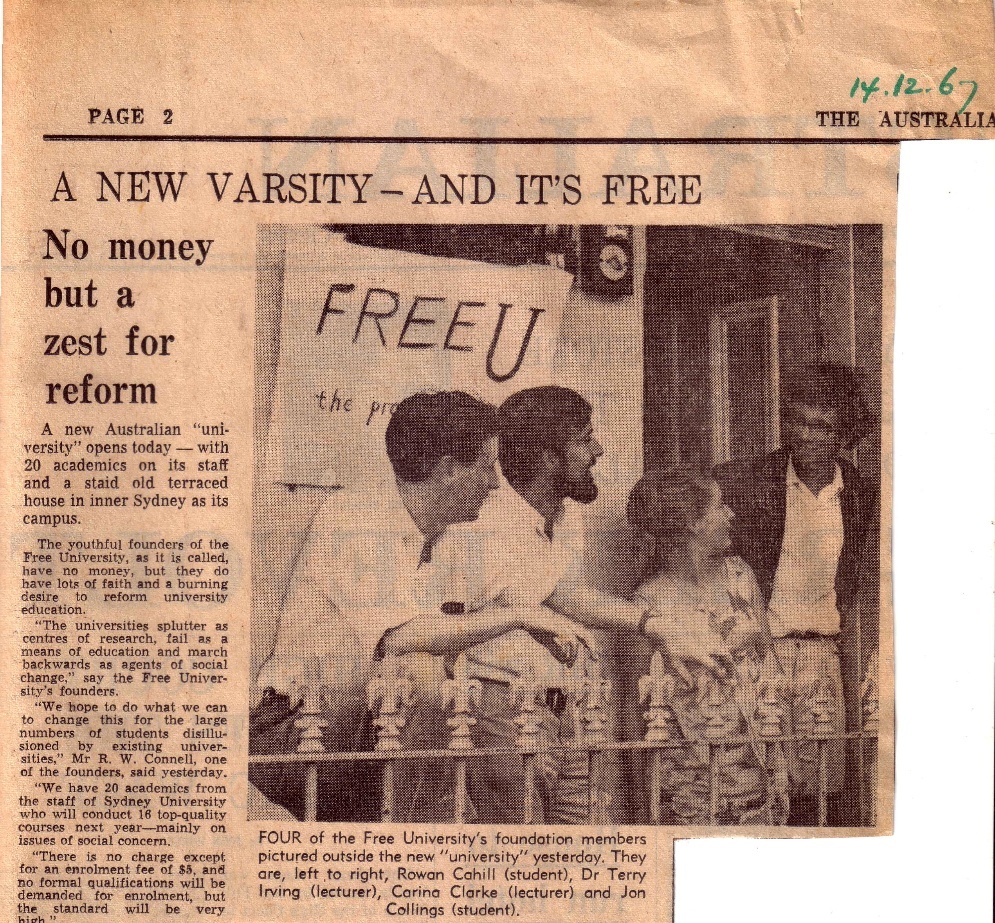
Terry: We were elated by the strong response to our publicity in Honi Soit announcing our decision to go ahead. About fifty persons attended a series of campus meetings, and soon committees were clarifying ideals, suggesting courses, raising money, negotiating with the new Vice-Chancellor, and publicizing the Free U. Who were they? By the time of the formal opening of the premises, a terrace house in Calder Street, near the main campus, there were 170 names on our enrolment forms. There was a ‘faculty’ of 19 convenors, mostly newly appointed tutors and lecturers, or post-graduate students aspiring to an academic career. We also attracted brief appearances for seminars and lectures from older and more established critical thinkers, including Norman Webb, Dick Thomson, Michael van Langenberg, Geoff Sorrell, Sol Encel, Peter Sculthorpe, Duncan Chappell, Peter Wertheim, Bill Ginnane, Eric Aarons and Alan Roberts. During the first year we held a successful three-day conference on poverty, a joint conference at Bundanoon with the Sydney Libertarians, and provided facilities for about twenty courses.
At the end of 1968 we left Calder Street for two larger premises, the old pub on the corner of Abercrombie and Shepherd streets, and the old manse of the Presbyterian Church on Oxford Street, Paddington. But there were signs of trouble ahead. In March 1969, only 97 members had paid in part or in full their enrolment fee of $10.00, and when a census of course participants was taken in the week from 3rd to 9th of March less than half had attended courses in 1968. We were finding it difficult to achieve continuity of focus and activity, although there was a committed core of about twenty to thirty. Membership was churning, regular participation was declining, the original organizers were running out of steam, and the existence of two campuses showed not growing strength but a disorienting diffuseness in the activities of the Free U.
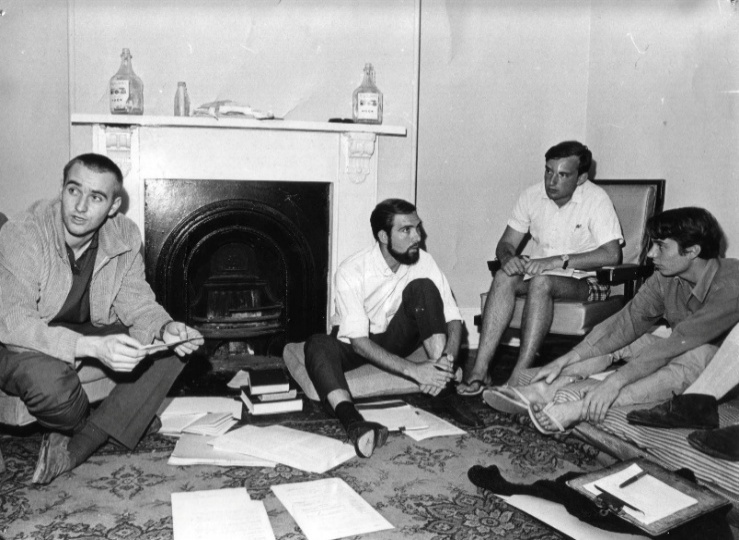
In fact, by January 1969 the Free U had evolved into something that the founders had not expected. We had thought of it as a proper university, working at the same intellectual level as existing universities, but with certain distinguishing features. As our manifesto, ‘The Lost Ideal’, expressed them: Free U would study issues and subjects frozen out of the regular curriculum; it would break down the division between students and staff; it would be based on co-operation not competition; and it would experiment with teaching methods.
At the same time, it was clear to us that we were driven by something besides educational experimentation and, at first, we called it a desire for community. The idea was nebulous. Of course, it had an educational reference, as in the phrase, ‘the community of scholars’, but really, we were reaching for a way to describe, in George Orwell’s words when he encountered the revolution in Barcelona, the ‘strange and moving experience’ of doing something new, of thumbing our nose at authority, of having an intense feeling of collective joy, and of working as a group. Our official Constitution described Free U as a ‘community of interested people involved in all the forms of its existence’. In ‘Inside the Free U’ Raewyn Connell wrote about the strong common feeling that was an essential part of making Free U work, and in an April 1968 article in Outlook Terry Irving over-egged the cake by describing the creation of this community as Free U’s greatest achievement.
As it turned out, these experiences were simply part of the euphoric moment of genesis. Free U found it increasingly difficult to sustain its community; it was too diverse in composition and purpose for that. And it was changing.
The main impetus for the change came from outside. During 1968, inspired by events in London, Paris and Prague, the New Left in Australia embarked on more dramatic forms of mobilization. At the same time, government agencies and corporations were exploiting the attraction of the counter-culture to young people who would have otherwise been caught up in generational revolt. Inside the Free U we soon felt the effects. There were two lines of criticism: first, suggestions that we should have closer links with the student movement and left organizations; and second, calls for ‘creative live-ins’ and courses on personal relationships. While Raewyn Connell continued to emphasize that radical thinking at Free U should centre on education, in practice our thinking was increasingly framed by the discourses of the wider radical movement and the youth culture.
Rowan: My association with the Free U was during its early stages. Beginning with some idealist thinking and imagining, I helped get it off the ground, ensured publicity, did some Calder Street house-sitting as a precaution against vandalism, gave a paper on the role of class in the short stories of Henry Lawson. But life was getting complex. I had an Honours degree to complete. My relationship with the state was increasingly fraught as I continued to defy the authorities that had conscripted me in 1965 and penalties for doing so were increasing. Imprisonment was a possibility. I was also increasingly involved in campus struggles; building the anti-war movement beyond the campus; and becoming more involved in left-wing journalism, publishing and writing. 1968 ended with the NSW government beginning criminal proceedings against me in my role as the publisher of Honi Soit, which down the track saw me in Court, facing trial by jury, conviction, and a suspended prison sentence.
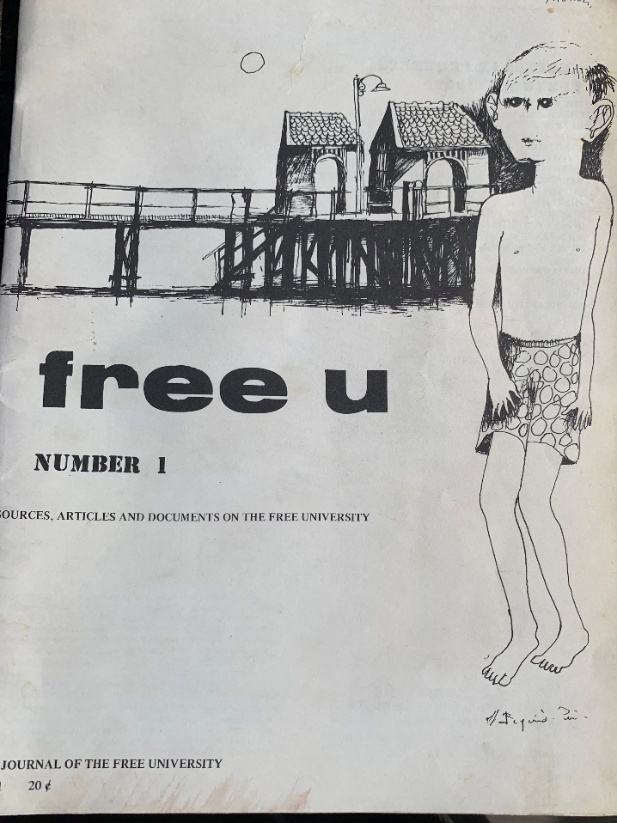
Terry: Honesty demanded that we could not ignore our own failures. Reflecting on the experiences of our first year, we decided that many problems arose because we could not nurture a common feeling of commitment and understanding so long as our program had to consist of a small number of courses with small enrolments meeting on different days of the week. There was just not enough inter-action. This meant, as Margaret Jolly wrote in the Free U –A Journal of the Free University, not only that we could never get a clear picture of the experiences and findings of courses but also that we were weakened in our capacity to use inter-action to encourage the spirit of student ownership of courses. The unfortunate truth was that there was still too much student passivity in some courses. The other side of the coin, as she pointed out, was an elitism in Free U, in particular a cult of personality around Connell and Irving. And so inevitably there was disengagement in the mass and a waning of enthusiasm in the elite.
By the end of 1968, we knew that novel, unconventional courses, and the ideal of education through participation, would not sustain the Free U for another year. On Sunday nights a core group of about 25 would gather to eat together and make decisions, but their energies were soon sapped by the continual need to address the tasks of administering the joint: record-keeping, networking, publicizing, typing and duplicating, to say nothing of cleaning and fund-raising. The rent on the premises at Calder Street had to be paid, but the terrace house was too small to permit of sub-tenanting or running a coffee shop. So inevitably our thoughts turned to bigger premises. Sub-letting to a few participants seemed the easiest way to cover overheads, and the presence of live-in students also promised a way to ‘provide continuity of action and direction’, as well as a constituency for the full-time courses that seemed so necessary for sustained involvement in social action in the surrounding suburbs, or for ‘experimental work in human relations’ (a.k.a. social action on each other). And so, the decision was taken to rent the old pub and the old manse.
By the time planning began for the 1968-9 Summer Session the effects of these pressures and problems were being felt in both the curriculum and the form of our classes. The activist ethos of the student movement, that had seemed so depleted when we set up Free U, and that we had hoped to side-step by making an educational revolution alongside other contingents of New Left activists, was now back in our thinking with a vengeance. A leaflet for the Summer Session 1968-9 announced that Free U would be co-operating with student groups at Sydney University and UNSW ‘in preparation for next year’s student action’. It went on: ‘Many Free University members have argued that there has been too much talk and not enough action: hence the Research and Action Projects. The summer session will push further some of the issues raised in the student movement this year – the failure of democracy in Australia; student power in the universities; the possibility of grass-roots social action; Vietnam and Australia’s role in Asia’. Among the projects suggested were community organizing in Redfern; working with First Nations organisations to produce research and community building; and strategies and proposals for reforming the mass university. These projects would build on courses in 1968 on poverty, Indigenous history, and students in the mass university, but it was clear that they were taking the Free U more in the direction of a social movement organisation than an educational counter institution.
In fact, the first Free U Newsletter for 1969 began with an essay that seemed like a new manifesto. It began, ‘The Free University of Redfern and Paddington has no bosses and has no workers, has no staff and has no students, has no Administration and alas no bureaucracy. It does have a lot of people who through courses and activities are attempting to understand themselves and their society.’ And then followed five ‘concepts of a Free University’ that had emerged over the previous 12 months of operation of Free U. This was startling: we had begun with one concept but now we had five. What were they? The first was familiar: the community of scholars, described as ‘groups of scholars all directly involved in the learning process’. Ditto, the second concept, which was described as our initial approach, ‘the radical educational experiment’, of learning in an unstructured situation that had given Free U its form. Now however it was antiquated. Now it needed to become wider, moving out from the course as traditionally understood to encompass human relations experiments and research and action projects. Third (and closely related to the second) was ‘the attraction of individual courses … that could not be studied elsewhere’. Some examples were given: drugs, mass media, class and power, Vietnam. Through these unconventional topics students were introduced to the general experience of participating in the Free U. Fair enough, but then came concepts four and five. Number four was ‘radical politics’, described as ‘the unity of theory and action: between the nihilist bomb-thrower and armchair strategist lies the research and action project’. Number five was ‘existential humanism’, described as a belief that places the freedom of the individual at the centre of creativity and purpose.
Looking back at those concepts today, it seems that numbers four and five took Free U into territory not envisaged by its founders, and number five was particularly difficult to accept. It shifted the focus from the structure to the agent. It was saying, unless we change the way individuals communicate and interact with each other we won’t be able to create a free educational community, let alone a new society. It was saying in effect: we can neglect the necessary interaction of structure and agency. Up at the manse, the live-in Free Uers were entranced by this one-sided emphasis, the popularity of their human relations course being built on exercises in sensory awareness and the formation of encounter groups.
By March 1969 it was evident that Free U was in crisis, squeezed between the student movement and the counter-culture. What was to be done? One response, in the words of David Taylor in Free U Journal, was to pin our salvation on developing ‘a warm and creative and tolerant and stimulating culture, and developing friendships’. Nice sentiment, but not very insightful. It was a response that ignored the need for purposive action around which such a culture might develop; and by the time David made this suggestion the idea of our purpose was confused. So, Raewyn Connell tried to bring us back to what Free U did, and how it might find a way to act in the future. Her strategy for doing this was to limit the distracting influence of the student power movement on us, by looking for stronger allies. While acknowledging that Free U was a product of the student movement, sharing its interest in ‘collective democracy’ and its culture of spontaneity and humour, it was different in a major way from the student movement. Our experiment did not attempt to ‘produce effects by direct action’ on other institutions. Rather, Free U attempted ‘to create change by setting up a working model of what the institution should be’. Free U was one of the revolutionary movement’s ‘pilot projects for the new society’. As such, its continued existence depended on moving beyond ‘student consciousness’ into ‘something deeper and more formidable’, and developing ‘programs of action which students share with others.’
This advice was right in principle. Alas, we lacked the resources and connections to put it into practice. In mid-1969 the leases on the manse and the pub were given up.
In retrospect, it is just as well that Free U was not alive a year later, for it would have been disrupted, perhaps fatally, by the emergence of the women’s movement. In truth, Free U was a very blokey institution – as an institution. There were plenty of young women around: in 1968 40 percent of the enrolees were young women, and they did most of the typing and administrative work. But in 1968 there was only one course with a female convenor and in 1969 there were only three. As one of those 1969 courses was convened by Ann Curthoys, who became a prominent member of the Sydney Women’s Liberation Group in 1970, it is pretty clear that Free U would have been a legitimate and deserving target for the struggle against sexism in left-wing organizations.
The (male) radical founders of Free U could only imagine an alternative form of university education because we could take advantage of a brief lull in the political contention of the sixties. By 1969 that short period of relative calm was over, succeeded by confrontations on the streets, on building sites, and in universities. At the same time, radical women were learning how to do their own consciousness-raising, and the counter-culture was drawing many young people away from collective struggle into self-centred conformism at best or drug culture at worst. Faced with the challenges of direct action, second wave feminism, and personal liberation, as radical energies were being diverted to other channels, the Free U disappeared. But its ideals – to build a knowledge that can help people to act, through self-managed education and people teaching each other – have not, and in Australia and internationally alternatives to mass, commodified education keep popping-up.
What surprises us now is how easily we learnt self-management. We had no instruction in it, but some of us did read Paul Goodman – humanist, community anarchist, radical educationist, and pacifist in World War II. In retrospect we should have organised a course on his thinking. Yet we fell into the self-managing mind-set almost instinctively. Not just by having to do the house-keeping tasks and using democratic decision-making to get them done, but finding that it was natural to organise in this way. Although we did not realise it at the time, The Free U was our introduction to radical democracy.
The ideals of free, self-managed education might be as ancient as Socrates but today they are needed more than ever. The isolating experience of impersonal zoom-based teaching, the market-originating pressure to vocationalise the curriculum, and the prospect of administrators and privately-owned curriculum providers foisting Massive Open Online Courses on universities are just the most overt signs of the weakness of those ideals in the universities. To strengthen them will require staff-student action and new radical ways of thinking about the purpose of universities. More generally, wherever people are organizing to free themselves from the tyranny of corporate neo-liberalism and its global economic and ecological crises there will come a moment when they realize the need to liberate knowledge as well.
Rowan: Sydney Free U keeps popping up in history, present for example in Hannah Forsyth, A History of the Modern Australian University (UNSW Press, 2014) and Richard Hil, Kristen Lyons, and Fern Thompsett, Transforming Universities in the Midst of Global Crisis: A University for the Common Good, (Routledge, 2022). Elsewhere it draws attention, as in the essay by Nina Dillon Britton, ‘The Free University: A People’s History’, Honi Soit, 26 October 2020. There is significant discussion of Free U in Ken Mansell’s comprehensive and extensively documented Socialist Students: A Narrative History of Australian Political Protest 1940-1970 (2024), a free pdf of which is available on the Labour History Melbourne website (https://labourhistorymelbourne.org/wp-content/uploads/2024/07/Socialist-Students-by-Ken-Mansell.pdf).
Earlier discussion is in Alan Barcan, From New Left to Factional Left: Fifty Years of Student Activism at Sydney University (Australian Scholarly Publishing, 2011). A significant critique of Free U is in Megan Jones, ‘Free U and the Politics of Knowledge’, Journal of Australian Studies, Volume 27, Issue 76, 2003. The impact of Free U upon Sydney University governance is discussed in Chapter 9 of W.F. Connell, G.E. Sherington, B.H. Fletcher, C. Turney and U. Bygott (editors), Australia’s First: A History of the University of Sydney, Volume 2 1940-1990 (1995). The Free U Archives, previously in the care of Terry, are now in the Archives of Sydney University and include a surviving copy of the comprehensive study by Geoff Manion, ‘The Free University of Sydney and the Age of Idealism’ (B.A. Honours, 1979).
In Australia it is becoming increasingly clear that in the university of the future, scholars of the humanities and social sciences kind, particularly those with social justice inclinations and imperatives, will find universities increasingly unwelcoming and themselves exiled from academies in which they used to find haven. And their numbers will be legion. If they wish to continue to deploy their skills for the common social good, then the example of Sydney Free U may well serve as an inspiration, and a moment in time and history to learn from.